Best AI Courses: 47 Free and Top-Rated Picks for 2026
You do not need a degree to learn AI. The 47 courses below mix free options from universities, Google, Microsoft and Hugging Face with top-rated Udemy courses from well-known instructors. We opened every link in November 2026, read the ratings ourselves and wrote the notes in our own words. Pick one path, finish it, then build something small. Looking for the tools themselves? Try our AI tools directory, the AI glossary for unfamiliar words, or the AI agents directory.
Start here (7)
No coding needed. Learn what AI is and how to think about it.
- 3
 BeginnerUdemy
365 Careers
Intro to AI Agents and Agentic AI
A short course on what AI agents are, how they work and where they fit in business, with no coding needed.
Good for: Non-coders who want to understand agents before building anything.
- 3
 BeginnerUdemy
365 Careers
Intro to AI: A Beginner's Guide to Artificial Intelligence
A short beginner guide to what AI is, how it works and how it affects business and careers.
Good for: Complete beginners who want a calm first look.
- 3
 All levelsUdemy
365 Careers
Intro to ChatGPT and Generative AI
A short introduction to using ChatGPT and other generative tools in daily work.
Good for: Beginners who want quick, practical habits.
- 3
 All levelsUdemy
365 Careers, Lauren Newbould
Intro to Large Language Models (LLMs)
A short explainer on how large language models work, what they can do and where they fail.
Good for: Anyone curious about the technology behind chat assistants.
- Y
 BeginnerUdemy
Yash Thakker
Generative AI for Leaders & Business Professionals
Explains generative AI for managers: where it helps, where it risks, and how to plan its use.
Good for: Leaders and business professionals.
- U
 BeginnerFree
University of Helsinki and MinnaLearn
Elements of AI
A plain-language introduction to what AI is, what it can and cannot do, and how it affects society. It needs no coding.
Good for: People who want the ideas first, with no programming.
- GBeginnerFree
Google
Machine Learning Crash Course
Google's own fast introduction to machine learning, with short lessons, visual explainers and practice exercises.
Good for: A quick, reliable base before touching code.
Machine learning foundations (14)
Courses that teach how models learn, with code.
- K
 All levelsUdemy
Kirill Eremenko, Hadelin de Ponteves
Machine Learning A-Z [2026]: ML, DL, AI with AWS, Python & R
Covers the main machine learning methods step by step, from regression to neural networks, with ready code templates in Python and R.
Good for: Learners who want one long course that covers the whole machine learning toolkit.
- K
 All levelsUdemy
Kirill Eremenko, Hadelin de Ponteves
Deep Learning A-Z [2026]: DL, AI in Python & AWS + LLM Prize
Teaches deep learning in Python with templates for neural networks, from the basics to more advanced models.
Good for: Learners who finished the basics and want neural networks.
- A
 All levelsUdemy
Andrei Neagoie, Daniel Bourke
Complete A.I. & Machine Learning, Data Science Bootcamp
A long bootcamp that takes you from Python and data analysis to machine learning projects.
Good for: Career changers who want a full path in one place.
- F
 All levelsUdemy
Frank Kane
Machine Learning, Data Science & AI Engineering with Python
A hands-on course covering data science, machine learning, deep learning and generative AI with Python.
Good for: Learners who prefer many small exercises.
- A
 All levelsUdemy
Ardit Sulce
Python Mega Course: Build 20 Real-World Apps and AI Agents
Teaches Python by building many small apps, then moves on to AI agents and automation projects.
Good for: Learners who like building a portfolio of projects.
- J
 All levelsUdemy
Javier Ide
Generative AI with PyTorch: From GANs to LLMs, Multimodal AI
Builds generative models in PyTorch, from early image models to modern multimodal ones.
Good for: Coders who want to understand how image and text generators work.
- K
 All levelsUdemy
Krish Naik
Complete Data Science,Machine Learning,DL,NLP Bootcamp
A very long course across data science, machine learning, deep learning, language processing and deployment.
Good for: Self-paced learners who want one big program.
- L
 All levelsUdemy
Lazy Programmer
[2026] Tensorflow 2: Deep Learning & Artificial Intelligence
Teaches deep learning with TensorFlow 2, from basic networks to more advanced models.
Good for: Coders who want depth and plenty of code.
- A
 All levelsUdemy
Andrei Neagoie, Daniel Bourke
TensorFlow for Deep Learning Bootcamp
A hands-on TensorFlow course with many projects, from basic networks to computer vision and text.
Good for: Learners who like building projects step by step.
- L
 IntermediateUdemy
Lazy Programmer
Artificial Intelligence: Reinforcement Learning in Python
Covers reinforcement learning, where programs learn by trial and reward, with Python code.
Good for: Intermediate learners ready for a more advanced topic.
- H
 IntermediateFree
Harvard
CS50's Introduction to AI with Python
A Harvard course covering search, knowledge, uncertainty, optimization, learning and language, with Python projects.
Good for: Learners comfortable with basic Python who want depth.
- F
 IntermediateFree
fast.ai
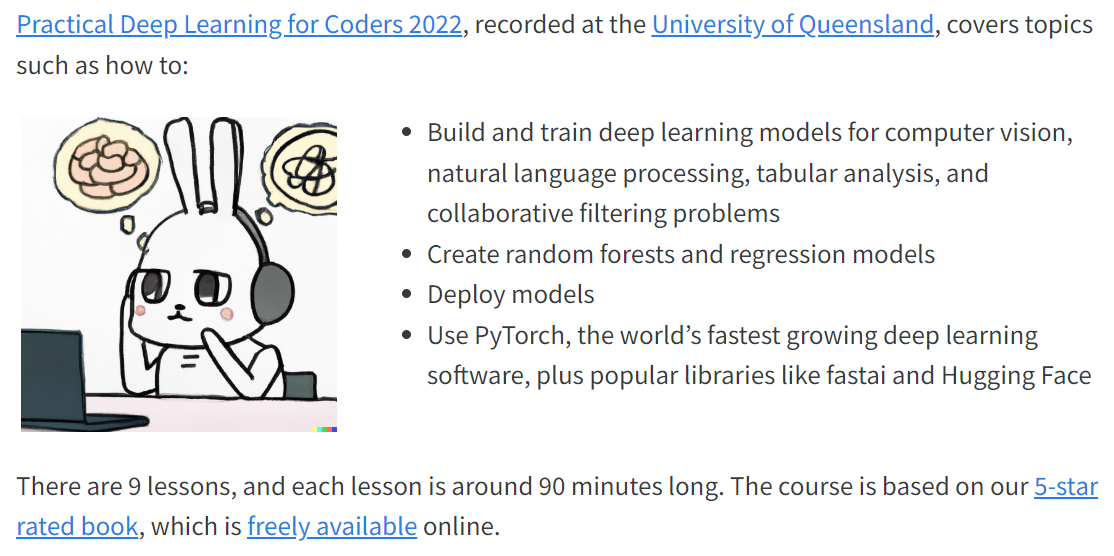
Practical Deep Learning for Coders
A code-first course that has you build working models early and explains the theory as you go.
Good for: Coders who learn by building.
- AIntermediateFree
Andrej Karpathy
Neural Networks: Zero to Hero
A video series that builds neural networks and a small language model from scratch, line by line.
Good for: Anyone who wants to truly understand how language models work.
- K
 BeginnerFree
Kaggle
Kaggle Learn
Bite-size interactive lessons on Python, pandas, data visualization and machine learning, with built-in notebooks.
Good for: Hands-on practice with real datasets.
Language models and agents (18)
Build with large language models, agents and tools.
- V
 All levelsUdemy
Valentin Despa
Introduction to OpenAI API & ChatGPT API for Developers
A short, practical introduction to calling OpenAI models from your own code and automations.
Good for: Beginners who want to connect ChatGPT-style models to their own apps.
- T
 All levelsUdemy
Tom Phillips
GitHub Copilot Beginner to Pro - AI for Coding & Development
Shows how to use GitHub Copilot to write, explain and fix code, including its agent features.
Good for: Developers new to AI coding assistants.
- E
 IntermediateUdemy
Eden Marco
LangChain & LangGraph AI Engineer: Agents, Agentic RAG & MCP
A project-based route into LangChain and LangGraph for building agents, retrieval-based apps and MCP tools.
Good for: Developers with some Python who want to build agent apps.
- E
 IntermediateUdemy
Ed Donner
AI Engineer Agentic Track: The Complete Agent & MCP Course
A hands-on track on building agents and MCP tools, taught through several worked projects.
Good for: Developers ready to build real multi-step agents.
- K
 All levelsUdemy
Krish Naik
Complete Generative AI Course With Langchain and Huggingface
A very long course on building generative AI apps with LangChain and Hugging Face tools.
Good for: Self-paced learners who want depth and lots of code.
- E
 All levelsUdemy
Ed Donner
AI Coder: Complete Claude Code & Coding Agents Course
Covers vibe coding with agents such as Claude Code, Copilot and Cursor, and how to keep control of what they write.
Good for: Vibe coders who want to work with coding agents more safely.
- E
 All levelsUdemy
Ed Donner
AI Engineer Core Track: LLM Engineering, RAG, QLoRA, Agents
Builds LLM apps over several weeks: retrieval, fine-tuning with LoRA, and agents, through eight projects.
Good for: Developers who want to become LLM engineers.
- N
 All levelsUdemy
Nikolai Schuler, Alejandro AO
Complete MCP Developer Guide: Agents, Servers & Tools
Explains the Model Context Protocol and walks through building servers and connecting tools to agents.
Good for: Builders who want to ship their own MCP servers. See our MCP directory too.
- 3
 All levelsUdemy
365 Careers
The AI Engineer Course 2026: Complete AI Engineer Bootcamp
A long bootcamp that covers Python, machine learning and building applications with language models.
Good for: People aiming for an AI engineer role.
- M
 All levelsUdemy
Mehmet Ozkaya
Generative AI Architectures with LLM, Prompt, RAG, Vector DB
Explains how to design apps around language models, with prompts, retrieval and vector databases.
Good for: Developers and architects planning a real system.
- H
 All levelsUdemy
Hitesh Choudhary, Piyush Garg
Full stack generative and Agentic AI with python
Shows how to build full applications that use language models and agents, using Python.
Good for: Developers who want to ship complete AI apps.
- H
 IntermediateFree
Hugging Face
LLM Course
Walks through how large language models are built and used, including the Transformers library and fine-tuning.
Good for: Developers who want to work with open models.
- H
 IntermediateFree
Hugging Face
AI Agents Course
Teaches how to design and build AI agents, from the basics to working projects.
Good for: Builders starting with agents.
- H
 IntermediateFree
Hugging Face
Model Context Protocol Course
Explains MCP and how to build servers and clients so assistants can use tools.
Good for: People who want to connect assistants to their own tools. See our MCP servers list too.
- M
BeginnerFree
Microsoft
Generative AI for Beginners
A set of 21 lessons with code samples on building apps with generative AI.
Good for: Beginners who want to ship a small app.
- MBeginnerFree
Microsoft
AI Agents for Beginners
Eighteen lessons that introduce agent design with code examples.
Good for: A gentle start with agents.
- DBeginnerFree
DeepLearning.AI
DeepLearning.AI short courses
Short, focused courses on topics such as prompting, RAG and agents, often taught with the tool makers.
Good for: Learning one specific skill in about an hour or two.
- LIntermediateFree
LangChain
LangChain Academy
Courses on building agents and applications with LangChain and LangGraph.
Good for: Developers using the LangChain tools.
Prompting and examples (8)
Get better results from the assistants you already use.
- M
 All levelsUdemy
Mike Taylor, James Phoenix
The Complete Prompt Engineering for AI Bootcamp (2026)
Teaches prompting as a working skill: structured prompts, testing them, and using them inside real code and tools.
Good for: Professionals who want to prompt reliably, not by trial and error.
- S
 All levelsUdemy
Steve Ballinger, MBA
ChatGPT: Complete ChatGPT Course For Work 2026 (Ethically)!
A work-focused ChatGPT course on writing, research, analysis and daily tasks, with attention to using AI responsibly.
Good for: Office workers and freelancers who want practical gains from ChatGPT.
- N
 All levelsUdemy
Navid Shirzadi
Prompt Engineering for Everyone Bootcamp
A short course on writing clearer prompts for chat assistants and image tools, with practice tasks.
Good for: Everyday users who want better answers.
- M
 All levelsUdemy
Maven Analytics
Generative AI Essentials: Prompt Engineering Masterclass
A short course on prompting techniques for work tasks such as analysis and writing.
Good for: Professionals who want a quick prompting skill-up.
- A
BeginnerFree
Anthropic
Anthropic courses
Educational notebooks from Anthropic on using Claude, including prompt engineering and tool use.
Good for: Practical prompting with worked examples.
- DBeginnerFree
DAIR.AI
Prompt Engineering Guide
A large reference guide to prompting techniques, with examples and papers.
Good for: Looking up a technique when you need it.
- LBeginnerFree
Learn Prompting
Learn Prompting
A step-by-step guide to talking to AI well, aimed at people with no technical background.
Good for: Non-coders who want better results from chat tools.
- O
 IntermediateFree
OpenAI
OpenAI Cookbook
A collection of runnable examples and guides for working with OpenAI models and APIs.
Good for: Developers who want copy-and-adapt examples.
How we pick Udemy courses
Udemy has thousands of AI courses and many are weak. We only list a course when it meets every rule below, checked on November 2026:
- Rated 4.5 or higher out of 5.
- At least 10,000 ratings from real students.
- Updated within the last 12 months, because AI courses age fast.
- Taught by a named instructor or team with a track record.
- Clear topic and outline, with no hype promises.
Udemy prices change often and courses are regularly on sale, so check the price on their page. We do not copy their descriptions. Ratings and student numbers change often, so we do not print them here. Check the live rating on each course page before you buy.
How to choose a course
- Start from your goal. To use AI at work, begin with a basics or prompting course. To build apps, pick a language model or agents course. To understand the maths, choose a foundations course.
- Check the level honestly. A course that assumes Python will frustrate you if you have never coded.
- Prefer courses with exercises. Watching alone fades fast, while building a small project makes it stick.
- Look at the date. AI changes quickly, so favour material updated in the last year.
- Finish one before starting the next. Three half-finished courses teach less than one finished course.
Questions people ask
Can I learn AI for free?
Yes. The free provider courses here, such as Google, Hugging Face, fast.ai and Harvard, cost nothing to follow. The Udemy courses are paid, and the cost line on each card says which is which.
Are the Udemy courses worth paying for?
If one matches your goal, often yes, especially during sales. Start with the free options, then pick one Udemy course when you want a guided project with a teacher.
Do you earn money from Udemy links?
Not at the moment. The links are plain links. If that ever changes, we will say so on this page.
Do I need to know how to code?
Not to start. Elements of AI and the prompting guides need no code. For the building courses, basic Python helps.
How long does it take?
A short course can take an evening. A full foundations course can take weeks of regular study. Set a small weekly goal you can keep.
Which course should a complete beginner choose?
Elements of AI for the big picture, then Google's Machine Learning Crash Course or a prompting guide, depending on whether you want to understand models or just use them well.
Will these help me get a job?
They build skills, but employers care most about what you have made. Finish a course, then publish a small project you can show.
Know a course that belongs here? Tell us and we will check it before listing it.